

Master the CELPIP Speaking Test: Simple Guide for All 8 Tasks
Are you nervous about the CELPIP Speaking test? You are not alone. Many students tell us this is the hardest part of the exam.
The good news:
CELPIP Speaking is very predictable. If you know the 8 tasks and you follow a clear structure, you can feel calm and speak with confidence.
This guide explains:
What happens in the CELPIP Speaking test
What the examiners want
Simple strategies for all 8 tasks
A practice plan you can follow at home
Potential support
1. What is the CELPIP Speaking Test?
CELPIP Speaking is a computer test. You do not talk to a real person. You:
Sit at a computer
Wear a headset with a microphone
Read or listen to a question on the screen
Speak your answer into the microphone
The test is about 15–20 minutes.
There are:
1 practice question (not scored)
8 real tasks (all scored)
The 8 tasks
Here is what you’ll face for CELPIP Speaking:
Giving Advice
Talking about a Personal Experience
Describing a Scene
Making Predictions
Comparing and Persuading
Dealing with a Difficult Situation
Expressing Opinions
Describing an Unusual Situation
You usually have 30–60 seconds to prepare and 60–90 seconds to speak, depending on the task.
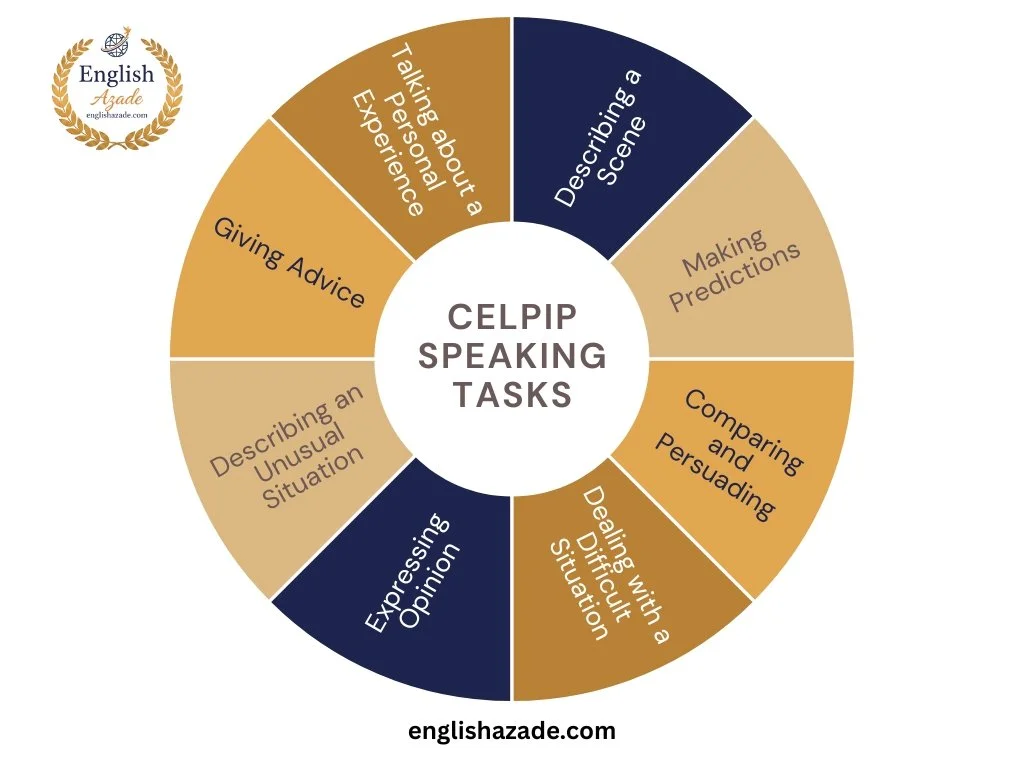
CELPIP Speaking’s 8 Tasks
2. How Is Your Speaking Score Decided?
Examiners listen to all your answers together and give one speaking score (0–12).
They check four main things:
Content & Coherence
Do you answer the question?
Are your ideas clear and well-organized?
Do you give examples?
Vocabulary
Do you use a good range of words?
Do you choose the right word for the situation?
Listenability (Fluency + Pronunciation + Grammar)
Do you speak clearly and at a natural speed?
Are your sentences mostly correct and easy to follow?
Task Fulfilment
Do you do what the task asks (give advice, compare, tell a story, etc.)?
💡 Important note:
You do not need “perfect” English. You need clear ideas + simple structure + mostly correct language.
3. 5 Big Skills to Improve Your CELPIP Speaking
These come from official CELPIP performance standards and teacher experience.
1) Know the 8 task types
If you know what is coming, you feel less stress.
Practice idea:
Make a small card with the 8 tasks. Look at it every day and say:
“Task 1 – give advice. Task 2 – personal story…”
2) Use a simple structure
For almost every task, this basic structure works:
Introduction – one clear sentence
Two or three main ideas – with short reasons or examples
Conclusion – one closing sentence
You will see examples of this for each task below.
3) Speak smoothly, not fast
Fluency means smooth speaking, not very fast speaking.
Use short pauses between ideas
Avoid long “uhhh… ummm…”
If you make a mistake, just correct yourself and continue
4) Use useful linking words
Simple connectors help your ideas sound organized:
First, second, finally
For example
Because / so / therefore
However / on the other hand
5) Control your time
Use a timer when you practise. For most tasks:
Plan: 30 seconds
Speak: 60–90 seconds
Try to speak until the end of the time. Do NOT stop after 20–30 seconds.
4. Task-by-Task Strategies (with Simple Templates)
Below are simple structures you can use.
Task 1 – Giving Advice
You listen to a friend’s problem and give advice.
Goal: Show that you understand the problem and give clear, helpful suggestions.
Easy structure:
Say you understand the problem
Give 2–3 pieces of advice
End with a friendly closing
Template:
First, I’m sorry you have this problem.
I think you should… [advice 1 + reason].
Another idea is to… [advice 2 + reason].
If possible, you can also… [advice 3 + reason].
I hope this helps you make a good decision.
Practice idea:
Write 5 common problems (new job, moving, noisy neighbour, etc.). Record yourself giving advice for each. Listen and check:
Did I give at least 2 pieces of advice?
Did I give reasons?
Task 2 – Talking About a Personal Experience
You tell a story about something that happened to you.
Goal: Clear story with beginning, middle, and end.
Easy structure (3 parts):
When and where – “Last year, in my hometown…”
What happened – 2 or 3 main events
How you felt / what you learned
Template:
I want to talk about a time when…
This happened [when] in [place].
First, …
Then, …
Finally, …
In the end, I felt… because…
It was important for me because…
Extra tip: Use past tense carefully (went, saw, bought, felt).
Task 3 – Describing a Scene
You look at a picture and describe what you see.
Goal: Show you can describe people, actions, and places.
Easy structure:
General sentence – where and what
Left side of the picture – 1 or 2 details
Right side of the picture – 1 or 2 details
Background / extra details
Useful language:
In the middle / on the left / on the right
In the background / in the foreground
A man is… / two children are…
Template:
In this picture, I can see…
On the left, there is…
On the right, …
In the background, …
Everyone looks… because…
Task 4 – Making Predictions
You see a picture and guess what will happen next.
Goal: Use future tense (will / going to) and give reasons.
Easy structure:
Describe the situation now (1 or 2 sentences)
Say what will happen next (2 or 3 ideas)
Give reasons
Template:
Right now, …
I think [person] will… because…
They will probably…
In the end, …
Task 5 – Comparing and Persuading
You compare two options and choose one.
Goal: Compare clearly and persuade your “friend” to choose your option.
Easy structure:
Say which option you prefer
Give 2 to 3 reasons
Mention one good point about the other option
Finish with a strong sentence
Useful language:
[Option A] is better because…
The first/second option
However, the other option is also…
Overall, I strongly recommend…
Template:
Between these two options, I would choose [option].
First, …
Second, …
Also, …
The other option is good because…, but…
Overall, I think [option] is better for you.
Task 6 – Dealing with a Difficult Situation
You are in a problem situation (for example, a mistake at work) and must respond.
Goal: Be polite, calm, and solution-focused.
Easy structure:
Say who you are and why you are calling/talking
Explain the problem
Offer 1 or 2 solutions
Stay polite, even if you are unhappy
Useful language:
I’m calling because…
I understand this is a problem.
Could you please…?
I would really appreciate it if…
Task 7 – Expressing Opinions
You give your opinion on a general topic (for example, online learning, public transport).
Goal: Clear opinion + 2–3 reasons + examples.
Easy structure:
State your opinion
Give reason 1 + example
Give reason 2 + example
Optional: reason 3 or short conclusion
Template:
In my opinion, …
First, … [reason + example].
Second, … [reason + example].
Overall, I believe…
Task 8 – Describing an Unusual Situation
You describe something strange and explain it to someone (often on the phone).
Goal: Make the strange event clear and easy to imagine.
Easy structure:
Say who you are and where you are
Describe what you see / what happened
Explain why it is unusual
Say what you want the other person to do
Template:
Hello, my name is… I’m calling from…
Right now, I can see…
This is unusual because…
I think maybe…
Could you please…?
5. Simple Practice Plan (2 Weeks)
Every day (15–20 minutes):
Choose one task type
Use your phone as a timer
Plan for 30 seconds
Record your answer (60–90 seconds)
Listen and ask:
Did I answer the question?
Did I follow my structure?
Did I speak until the end of the time?
3 times a week:
Choose one recording
Write a short transcript of what you said
Underline mistakes with grammar or vocabulary
Re-record the answer with better language
Once a week:
Ask a friend/teacher to listen
Ask them:
Was my answer clear?
Were my ideas organized?
Did I sound confident?
All these steps match the skills CELPIP raters want to see: good content, vocabulary, fluency, and task completion.
6. Common Mistakes (and Easy Fixes)

Mistake 1: Very short answers
Some students stop after 20–30 seconds.
Fix:
Always prepare at least two main ideas + examples.
Practise with a timer and push yourself to speak longer.
Mistake 2: Off-topic answers
Students tell a nice story but do not answer the question.
Fix:
In the first sentence, repeat part of the question:
“You asked me to give you advice about…”
Mistake 3: Very complex sentences with many errors
Fix:
Use short, clear sentences:
“First, I think you should… because…”
Mistake 4: Speaking too fast or too slow
Fix:
Aim for a medium speed.
Record yourself and listen: can you understand every word?
7. How English Azade Can Help You
At English Azade, we work with small groups (4 to 5 students) in our semi-private CELPIP Speaking classes.
In class, you:
Practise all 8 tasks many times
Get personal feedback on pronunciation, grammar, and ideas
Learn ready-to-use templates like the ones in this post
Build confidence by speaking in a supportive group
If you want structured practice and expert feedback, joining Azade’s speaking class can save you a lot of time and help you reach your target score faster.